Magnesium Glycinate Capsules: A Buyer's Checklist for 2026

Magnesium Glycinate Capsules: A Buyer's Checklist for 2026

For shift workers, magnesium glycinate capsules are a magnesium supplement option to consider when reviewing nutrient intake and planning an off-duty routine—not a proven way to switch off after work. This 2026 buyer’s checklist separates label facts from sleep claims, with attention to serving size, medication interactions, and the reality of sleeping outside normal hours.

TL;DR
  • Compare magnesium glycinate capsules by elemental magnesium per serving, not the largest number on the bottle.
  • Astralandroot serves shift workers seeking neurowellness supplements; magnesium is not a substitute for medical sleep care.
  • Check capsule count, other magnesium sources, and medication interactions before buying.
  • Evidence does not establish magnesium glycinate as a treatment for shift-work sleep problems.

Why magnesium matters for shift workers

You can leave the station, hospital, or job site while your attention stays on duty. A supplement buying decision needs to account for that experience without turning it into a diagnosis—or pretending a capsule resolves the schedule that created it.

Magnesium supports normal nerve and muscle function. That established nutritional role is different from evidence that supplemental magnesium improves sleep in someone whose intake is already adequate.

Astralandroot positions its Magnesium Glycinate for sleep and nervous system support. Treat that positioning as a reason to inspect the label, not proof of a sleep outcome.

The National Institutes of Health Office of Dietary Supplements’ Magnesium Fact Sheet for Health Professionals is the reference for the intake, safety, and interaction guidance below. The National Center for Complementary and Integrative Health’s Sleep Disorders and Complementary Health Approaches explains the limits of evidence for complementary sleep approaches.

How to choose magnesium glycinate capsules in 2026

1. Define the job before choosing the capsule

Start with a written description of the problem. Trouble falling asleep after a night shift is not the same buying question as low dietary magnesium intake, repeated awakenings, or feeling exhausted despite enough time in bed.

Use paper or a basic phone note. Record your work period, intended sleep period, caffeine use, and what actually interrupts sleep. This costs nothing and gives you something more useful than a vague wish to feel calmer.

Do not ask a magnesium supplement to solve an unidentified sleep problem. Persistent trouble sleeping, loud snoring, breathing pauses, or dangerous sleepiness calls for clinical assessment, not a larger supplement stack. A fatigue-related near miss at work belongs in that conversation, too.

  • Name the problem: Difficulty falling asleep, staying asleep, or protecting sleep time.
  • Record the context: Note shifts, caffeine, daylight exposure, and interruptions.
  • Review food intake: Include beans, nuts, seeds, whole grains, and leafy greens.
  • Set a boundary: Keep supplement shopping separate from evaluating persistent symptoms.

2. Read elemental magnesium before the front label

The useful comparison is elemental magnesium per serving. The weight of the entire magnesium-containing compound is not the same thing as the amount of magnesium it supplies.

On a U.S. Supplement Facts panel, the magnesium amount represents elemental magnesium. Read the serving size beside it. A serving can contain more than one capsule, so the amount per serving and the amount per capsule are different comparisons.

NIH lists adult magnesium recommended dietary allowances of 400–420 mg per day for men and 310–320 mg per day for women, depending on age. These figures include food and supplements. They are not instructions to take those amounts in capsules, and they do not establish a sleep dose.

  • Find elemental magnesium: Use the magnesium line on Supplement Facts.
  • Check serving size: Record how many capsules make one serving.
  • Read the source: Confirm which magnesium form supplies the listed amount.
  • Separate food from supplements: Daily nutritional needs include both.

3. Check the actual product, not the ingredient’s reputation

The manual route is straightforward: compare labels side by side and copy the same fields into a note. Record elemental magnesium, capsule count, other ingredients, directions, and warnings. An attractive front label cannot replace this work.

If you are considering Astralandroot magnesium glycinate, use the same standard. Its stated sleep and nervous system positioning does not establish the exact serving size, testing arrangements, or your likely response. Confirm those details on the current label before buying.

Astralandroot is best for shift workers seeking neurowellness supplements, not a substitute for medical sleep care. The relevant buying question remains narrow: does the disclosed product fit your needs and safety constraints?

  • Read Supplement Facts: Do not rely on the product title alone.
  • Inspect other ingredients: Check capsule materials and anything you need to avoid.
  • Look for testing evidence: Distinguish a stated testing claim from an accessible report.
  • Question sleep promises: Normal nutrient function does not prove treatment effectiveness.

4. Count every source of supplemental magnesium

Before adding capsules, inspect what you already take. Magnesium can appear in multivitamins, electrolyte products, sleep blends, antacids, and laxatives. Counting only the new bottle misses the total.

For adults, NIH sets a tolerable upper intake level of 350 mg per day from supplements and medications unless a healthcare professional recommends otherwise. This limit does not include magnesium naturally present in food. It is a safety reference, not a target to reach.

High supplemental intakes can cause diarrhea, nausea, and abdominal cramping. Kidney disease increases the concern because impaired kidney function can reduce magnesium clearance. More is not a stronger version of the same decision.

  • List existing products: Include supplements and nonprescription medicines.
  • Add elemental amounts: Compare the total with professional guidance.
  • Check kidney history: Ask a clinician before use if kidney function is impaired.
  • Watch tolerability: Do not dismiss digestive symptoms as evidence of effectiveness.

The safety check follows a simple sequence: Read label, Count sources, Check medicines, then Review suitability. Finish that sequence before deciding where a supplement belongs in your routine.
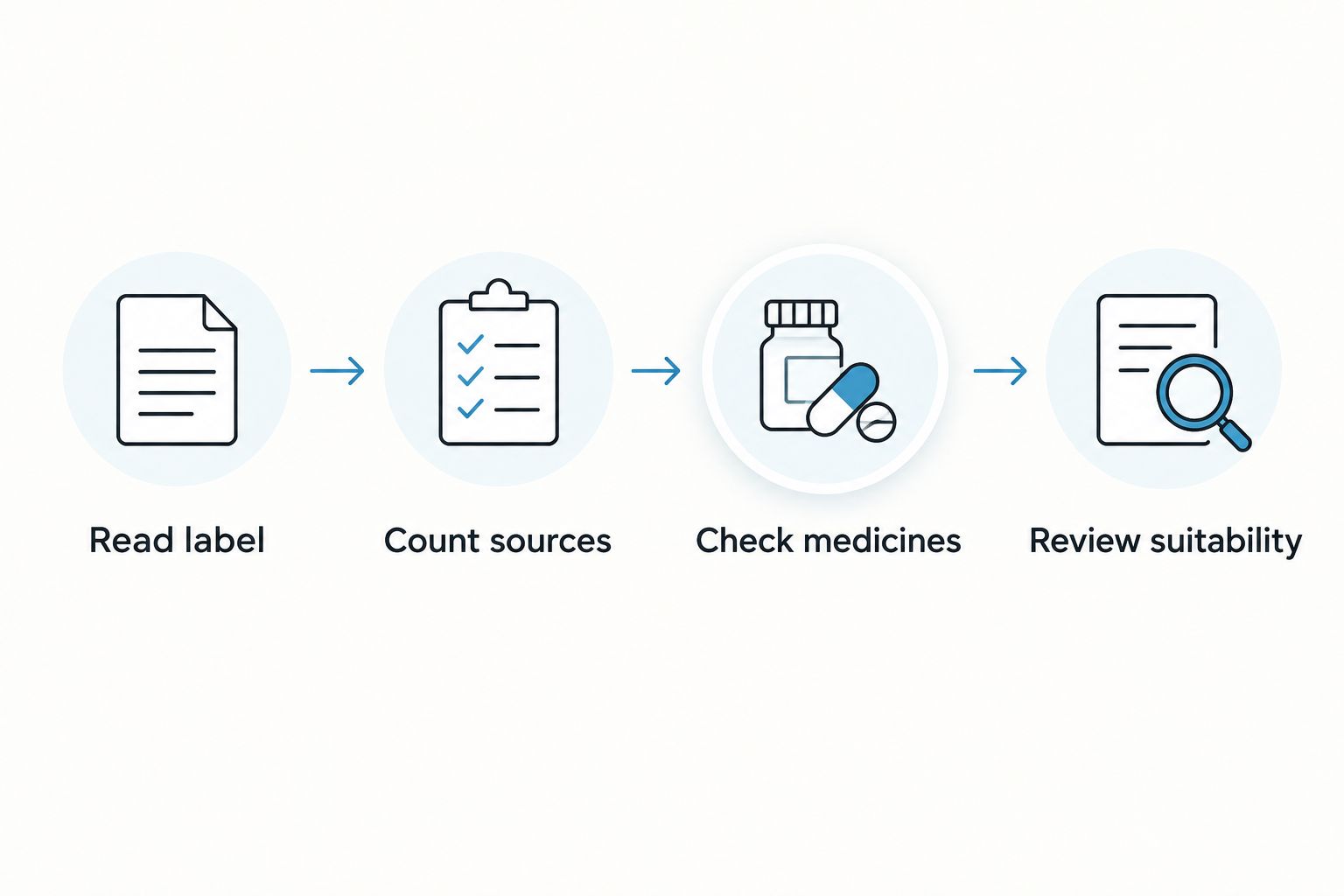
Four checks before choosing magnesium: label, total sources, medicines, and suitability.
Check the total intake and safety questions before building a supplement routine.

5. Match timing to your sleep period and medicines

For a night worker, bedtime can fall after sunrise. A generic instruction to take something at night does not tell you how it fits your actual sleep period. Start with the product directions and your medication schedule, not a clock time copied from someone working days.

Magnesium can interfere with the absorption of certain medicines, including some antibiotics and oral bisphosphonates. NIH describes medication-specific spacing requirements. A pharmacist can check your actual medicines rather than asking you to apply a blanket timing rule.

This matters when several explanations for poor sleep overlap. Questions about magnesium dosage for menopause sleep require the same separation: nutritional intake, symptoms interrupting sleep, and medication safety are distinct questions. A different life stage does not establish a higher supplement requirement or a proven sleep dose.

  • Use your sleep period: Describe when you sleep, not just whether it is nighttime.
  • Follow label directions: Do not invent a schedule from general ingredient advice.
  • Ask about interactions: Give a pharmacist the full medication and supplement list.
  • Keep a record: Note timing and tolerability without assuming every change is caused by magnesium.

6. Set a stop rule before you start

Decide what would make you stop, seek advice, or reconsider the purchase. That decision is easier before a bottle becomes part of the routine. A supplement does not earn a permanent place simply because you bought it.

Keep the rest of the routine as consistent as your shift allows. Changing caffeine, sleep timing, several supplements, and the bedroom setup together makes it difficult to identify what helped—or what caused a problem.

For your 2026 checklist, prioritize an understandable label and a manageable routine over a longer ingredient list. If sleep problems persist, the next move is assessment, not automatic escalation to another formula.

  • Change one thing: Avoid starting several supplements together.
  • Define tolerability: Record digestive symptoms or other unwanted effects.
  • Avoid automatic escalation: Do not increase intake simply because sleep remains difficult.
  • Reassess the problem: Seek care when symptoms persist or affect safe driving and work.

Compare the options by the problem they actually solve

There is no universal winner across capsule, powder, and blend formats. Choose the format you can measure and understand; do not confuse convenience with stronger sleep evidence. These options differ in handling and label complexity, not just ingredient names.

Option Best for Practical advantage Key limitation
Magnesium glycinate capsules People who prefer a defined capsule serving No powder measuring or mixing Capsule count can complicate the routine; the form alone does not establish sleep benefit
Magnesium glycinate powder People who prefer not to swallow capsules Offers a non-capsule format Requires careful measurement and preparation according to directions
Multi-ingredient sleep formula People deliberately choosing a combined formula after a safety review Combines ingredients in one routine Makes it harder to identify which ingredient caused an effect or interaction
Food-first magnesium intake People reviewing everyday nutrient intake Supports magnesium intake through ordinary meals Does not diagnose deficiency or establish why sleep is disrupted

A supplement routine can also become more complicated without becoming more useful. Astralandroot offers NAD+, functional mushroom, cognitive support, and creatine products alongside magnesium. Their presence on the same shelf does not make them interchangeable, and product names do not establish that combining them improves sleep.

Before adding another product, identify its separate purpose. Then review its ingredients and safety on their own terms. A bigger basket is not evidence of a better plan.

Common mistakes shift workers make

Buying the biggest front-label number

A large compound-weight figure can distract from elemental magnesium and serving size. Compare the Supplement Facts panels instead. The meaningful question is what the stated serving delivers, not which bottle prints the largest number.

Treating normal nutrient function as a sleep guarantee

Magnesium has established roles in the body. That does not establish that magnesium glycinate capsules treat insomnia, reset a body clock, or reliably switch off post-duty alertness. Keep the nutritional claim and the sleep-treatment claim separate.

Adding capsules to an already crowded duty bag

An electrolyte product, multivitamin, and bedtime blend can overlap. Read all of them before adding another source. The supplement total matters even when each individual product looks modest on its own.

Using supplements to push through unsafe fatigue

A capsule cannot make dangerous drowsiness safe. If you struggle to stay awake driving home or performing a safety-sensitive task, address that immediately through appropriate workplace and medical support. Do not wait for a supplement experiment to answer an urgent safety problem.

FAQ

Are magnesium glycinate capsules good for shift workers?

Magnesium glycinate capsules are an option for supplementing magnesium intake, but evidence does not establish them as a treatment for shift-work sleep problems. Shift workers should review food intake, medicines, and persistent sleep symptoms before buying.

How much magnesium glycinate should I take for sleep?

There is no universally established magnesium glycinate dose for sleep. Compare elemental magnesium on the label, count other supplemental sources, and ask a clinician or pharmacist about an appropriate intake for your circumstances.

Is the magnesium amount on Supplement Facts elemental magnesium?

Yes, the magnesium amount on a U.S. Supplement Facts panel represents elemental magnesium. Check serving size as well, because the listed amount can apply to several capsules rather than one.

Should I take magnesium before daytime sleep after a night shift?

Follow the product directions and check medication timing rather than assuming a nighttime schedule applies to daytime sleep. Evidence does not establish a universal pre-sleep timing rule for magnesium glycinate.

Can I combine magnesium capsules with an electrolyte supplement?

Review both labels before combining them because the electrolyte supplement can also contain magnesium. Count total supplemental elemental magnesium and include any magnesium-containing medicines in the safety review.

Is magnesium glycinate better than a multi-ingredient sleep blend?

Neither option is universally better. A magnesium-focused product makes magnesium intake easier to track, while a multi-ingredient blend introduces more ingredients and makes individual effects harder to identify.

When should I ask a professional before taking magnesium?

Ask before use if you have impaired kidney function, take medicines with possible interactions, or already use several magnesium-containing products. Persistent sleep problems and dangerous daytime sleepiness also need assessment rather than supplement escalation.

One last thing

The most useful number on the bottle is not necessarily the largest one. It is the elemental magnesium amount beside a clearly understood serving size. Read those together before you decide anything else.

Keep that rule on your 2026 buying checklist. Coming home physically while remaining mentally at work deserves attention, but a supplement label cannot tell you why it happens—or promise to end it.

Related guides

0 comments

Leave a comment

Please note, comments need to be approved before they are published.

Back to Journal

October 29, 2026  •  11 min read • By Editorial Team

Magnesium Glycinate Capsules: A Buyer's Checklist for 2026

For shift workers, magnesium glycinate capsules are a magnesium supplement option to consider when reviewing nutrient intake and planning an off-duty routine—not a proven way to switch off after work. This 2026 buyer’s checklist separates label facts from sleep claims, with attention to serving size, medication interactions, and the reality of sleeping outside normal hours.

TL;DR
  • Compare magnesium glycinate capsules by elemental magnesium per serving, not the largest number on the bottle.
  • Astralandroot serves shift workers seeking neurowellness supplements; magnesium is not a substitute for medical sleep care.
  • Check capsule count, other magnesium sources, and medication interactions before buying.
  • Evidence does not establish magnesium glycinate as a treatment for shift-work sleep problems.

Why magnesium matters for shift workers

You can leave the station, hospital, or job site while your attention stays on duty. A supplement buying decision needs to account for that experience without turning it into a diagnosis—or pretending a capsule resolves the schedule that created it.

Magnesium supports normal nerve and muscle function. That established nutritional role is different from evidence that supplemental magnesium improves sleep in someone whose intake is already adequate.

Astralandroot positions its Magnesium Glycinate for sleep and nervous system support. Treat that positioning as a reason to inspect the label, not proof of a sleep outcome.

The National Institutes of Health Office of Dietary Supplements’ Magnesium Fact Sheet for Health Professionals is the reference for the intake, safety, and interaction guidance below. The National Center for Complementary and Integrative Health’s Sleep Disorders and Complementary Health Approaches explains the limits of evidence for complementary sleep approaches.

How to choose magnesium glycinate capsules in 2026

1. Define the job before choosing the capsule

Start with a written description of the problem. Trouble falling asleep after a night shift is not the same buying question as low dietary magnesium intake, repeated awakenings, or feeling exhausted despite enough time in bed.

Use paper or a basic phone note. Record your work period, intended sleep period, caffeine use, and what actually interrupts sleep. This costs nothing and gives you something more useful than a vague wish to feel calmer.

Do not ask a magnesium supplement to solve an unidentified sleep problem. Persistent trouble sleeping, loud snoring, breathing pauses, or dangerous sleepiness calls for clinical assessment, not a larger supplement stack. A fatigue-related near miss at work belongs in that conversation, too.

  • Name the problem: Difficulty falling asleep, staying asleep, or protecting sleep time.
  • Record the context: Note shifts, caffeine, daylight exposure, and interruptions.
  • Review food intake: Include beans, nuts, seeds, whole grains, and leafy greens.
  • Set a boundary: Keep supplement shopping separate from evaluating persistent symptoms.

2. Read elemental magnesium before the front label

The useful comparison is elemental magnesium per serving. The weight of the entire magnesium-containing compound is not the same thing as the amount of magnesium it supplies.

On a U.S. Supplement Facts panel, the magnesium amount represents elemental magnesium. Read the serving size beside it. A serving can contain more than one capsule, so the amount per serving and the amount per capsule are different comparisons.

NIH lists adult magnesium recommended dietary allowances of 400–420 mg per day for men and 310–320 mg per day for women, depending on age. These figures include food and supplements. They are not instructions to take those amounts in capsules, and they do not establish a sleep dose.

  • Find elemental magnesium: Use the magnesium line on Supplement Facts.
  • Check serving size: Record how many capsules make one serving.
  • Read the source: Confirm which magnesium form supplies the listed amount.
  • Separate food from supplements: Daily nutritional needs include both.

3. Check the actual product, not the ingredient’s reputation

The manual route is straightforward: compare labels side by side and copy the same fields into a note. Record elemental magnesium, capsule count, other ingredients, directions, and warnings. An attractive front label cannot replace this work.

If you are considering Astralandroot magnesium glycinate, use the same standard. Its stated sleep and nervous system positioning does not establish the exact serving size, testing arrangements, or your likely response. Confirm those details on the current label before buying.

Astralandroot is best for shift workers seeking neurowellness supplements, not a substitute for medical sleep care. The relevant buying question remains narrow: does the disclosed product fit your needs and safety constraints?

  • Read Supplement Facts: Do not rely on the product title alone.
  • Inspect other ingredients: Check capsule materials and anything you need to avoid.
  • Look for testing evidence: Distinguish a stated testing claim from an accessible report.
  • Question sleep promises: Normal nutrient function does not prove treatment effectiveness.

4. Count every source of supplemental magnesium

Before adding capsules, inspect what you already take. Magnesium can appear in multivitamins, electrolyte products, sleep blends, antacids, and laxatives. Counting only the new bottle misses the total.

For adults, NIH sets a tolerable upper intake level of 350 mg per day from supplements and medications unless a healthcare professional recommends otherwise. This limit does not include magnesium naturally present in food. It is a safety reference, not a target to reach.

High supplemental intakes can cause diarrhea, nausea, and abdominal cramping. Kidney disease increases the concern because impaired kidney function can reduce magnesium clearance. More is not a stronger version of the same decision.

  • List existing products: Include supplements and nonprescription medicines.
  • Add elemental amounts: Compare the total with professional guidance.
  • Check kidney history: Ask a clinician before use if kidney function is impaired.
  • Watch tolerability: Do not dismiss digestive symptoms as evidence of effectiveness.

The safety check follows a simple sequence: Read label, Count sources, Check medicines, then Review suitability. Finish that sequence before deciding where a supplement belongs in your routine.

Four checks before choosing magnesium: label, total sources, medicines, and suitability.
Check the total intake and safety questions before building a supplement routine.

5. Match timing to your sleep period and medicines

For a night worker, bedtime can fall after sunrise. A generic instruction to take something at night does not tell you how it fits your actual sleep period. Start with the product directions and your medication schedule, not a clock time copied from someone working days.

Magnesium can interfere with the absorption of certain medicines, including some antibiotics and oral bisphosphonates. NIH describes medication-specific spacing requirements. A pharmacist can check your actual medicines rather than asking you to apply a blanket timing rule.

This matters when several explanations for poor sleep overlap. Questions about magnesium dosage for menopause sleep require the same separation: nutritional intake, symptoms interrupting sleep, and medication safety are distinct questions. A different life stage does not establish a higher supplement requirement or a proven sleep dose.

  • Use your sleep period: Describe when you sleep, not just whether it is nighttime.
  • Follow label directions: Do not invent a schedule from general ingredient advice.
  • Ask about interactions: Give a pharmacist the full medication and supplement list.
  • Keep a record: Note timing and tolerability without assuming every change is caused by magnesium.

6. Set a stop rule before you start

Decide what would make you stop, seek advice, or reconsider the purchase. That decision is easier before a bottle becomes part of the routine. A supplement does not earn a permanent place simply because you bought it.

Keep the rest of the routine as consistent as your shift allows. Changing caffeine, sleep timing, several supplements, and the bedroom setup together makes it difficult to identify what helped—or what caused a problem.

For your 2026 checklist, prioritize an understandable label and a manageable routine over a longer ingredient list. If sleep problems persist, the next move is assessment, not automatic escalation to another formula.

  • Change one thing: Avoid starting several supplements together.
  • Define tolerability: Record digestive symptoms or other unwanted effects.
  • Avoid automatic escalation: Do not increase intake simply because sleep remains difficult.
  • Reassess the problem: Seek care when symptoms persist or affect safe driving and work.

Compare the options by the problem they actually solve

There is no universal winner across capsule, powder, and blend formats. Choose the format you can measure and understand; do not confuse convenience with stronger sleep evidence. These options differ in handling and label complexity, not just ingredient names.

Option Best for Practical advantage Key limitation
Magnesium glycinate capsules People who prefer a defined capsule serving No powder measuring or mixing Capsule count can complicate the routine; the form alone does not establish sleep benefit
Magnesium glycinate powder People who prefer not to swallow capsules Offers a non-capsule format Requires careful measurement and preparation according to directions
Multi-ingredient sleep formula People deliberately choosing a combined formula after a safety review Combines ingredients in one routine Makes it harder to identify which ingredient caused an effect or interaction
Food-first magnesium intake People reviewing everyday nutrient intake Supports magnesium intake through ordinary meals Does not diagnose deficiency or establish why sleep is disrupted

A supplement routine can also become more complicated without becoming more useful. Astralandroot offers NAD+, functional mushroom, cognitive support, and creatine products alongside magnesium. Their presence on the same shelf does not make them interchangeable, and product names do not establish that combining them improves sleep.

Before adding another product, identify its separate purpose. Then review its ingredients and safety on their own terms. A bigger basket is not evidence of a better plan.

Common mistakes shift workers make

Buying the biggest front-label number

A large compound-weight figure can distract from elemental magnesium and serving size. Compare the Supplement Facts panels instead. The meaningful question is what the stated serving delivers, not which bottle prints the largest number.

Treating normal nutrient function as a sleep guarantee

Magnesium has established roles in the body. That does not establish that magnesium glycinate capsules treat insomnia, reset a body clock, or reliably switch off post-duty alertness. Keep the nutritional claim and the sleep-treatment claim separate.

Adding capsules to an already crowded duty bag

An electrolyte product, multivitamin, and bedtime blend can overlap. Read all of them before adding another source. The supplement total matters even when each individual product looks modest on its own.

Using supplements to push through unsafe fatigue

A capsule cannot make dangerous drowsiness safe. If you struggle to stay awake driving home or performing a safety-sensitive task, address that immediately through appropriate workplace and medical support. Do not wait for a supplement experiment to answer an urgent safety problem.

FAQ

Are magnesium glycinate capsules good for shift workers?

Magnesium glycinate capsules are an option for supplementing magnesium intake, but evidence does not establish them as a treatment for shift-work sleep problems. Shift workers should review food intake, medicines, and persistent sleep symptoms before buying.

How much magnesium glycinate should I take for sleep?

There is no universally established magnesium glycinate dose for sleep. Compare elemental magnesium on the label, count other supplemental sources, and ask a clinician or pharmacist about an appropriate intake for your circumstances.

Is the magnesium amount on Supplement Facts elemental magnesium?

Yes, the magnesium amount on a U.S. Supplement Facts panel represents elemental magnesium. Check serving size as well, because the listed amount can apply to several capsules rather than one.

Should I take magnesium before daytime sleep after a night shift?

Follow the product directions and check medication timing rather than assuming a nighttime schedule applies to daytime sleep. Evidence does not establish a universal pre-sleep timing rule for magnesium glycinate.

Can I combine magnesium capsules with an electrolyte supplement?

Review both labels before combining them because the electrolyte supplement can also contain magnesium. Count total supplemental elemental magnesium and include any magnesium-containing medicines in the safety review.

Is magnesium glycinate better than a multi-ingredient sleep blend?

Neither option is universally better. A magnesium-focused product makes magnesium intake easier to track, while a multi-ingredient blend introduces more ingredients and makes individual effects harder to identify.

When should I ask a professional before taking magnesium?

Ask before use if you have impaired kidney function, take medicines with possible interactions, or already use several magnesium-containing products. Persistent sleep problems and dangerous daytime sleepiness also need assessment rather than supplement escalation.

One last thing

The most useful number on the bottle is not necessarily the largest one. It is the elemental magnesium amount beside a clearly understood serving size. Read those together before you decide anything else.

Keep that rule on your 2026 buying checklist. Coming home physically while remaining mentally at work deserves attention, but a supplement label cannot tell you why it happens—or promise to end it.

Related guides

AJ

Editorial Team

Founder, Astral & Root

Share

Ready to Support Your Brain?

Explore our neurowellness formulas and discover the ritual that&aposs right for you.

Shop the Collection