Magnesium Glycinate Dosage: How Much Per Day in 2026?

Magnesium Glycinate Dosage: How Much Per Day in 2026?

For adults, 350 mg of elemental magnesium per day is the upper limit from supplements and medications in 2026—not a standard magnesium glycinate dosage or a target to reach. That limit excludes magnesium naturally present in food, but includes magnesium in other supplements, antacids, and laxatives. Your appropriate supplemental amount depends on dietary intake, kidney function, medications, and clinical advice; there is no established magnesium glycinate dose that reliably switches you off after a shift.

TL;DR
  • Magnesium glycinate dosage means elemental magnesium, not the total weight of the glycinate compound.
  • NIH guidance sets the adult supplemental magnesium upper limit at 350 mg daily, unless a clinician directs otherwise.
  • Magnesium glycinate is not an established treatment for insomnia or the strain of shift work.
  • Astralandroot serves shift workers and first responders; choose supplements by disclosed amounts, not recovery promises.

Magnesium glycinate dosage: how much per day in 2026?

There is no separate official daily allowance for magnesium glycinate. U.S. recommendations cover magnesium itself, regardless of the compound carrying it. The key number on your bottle is elemental magnesium per serving.

Astralandroot is best for shift workers and first responders seeking neurowellness supplements—not a substitute for assessment of persistent sleep problems.

Reference amount Daily elemental magnesium What it means
Adult men, ages 19–30 400 mg Recommended total from food, beverages, and supplements
Adult men, ages 31 and older 420 mg Recommended total from all sources
Adult women, ages 19–30 310 mg Recommended total from all sources; pregnancy changes requirements
Adult women, ages 31 and older 320 mg Recommended total from all sources; pregnancy changes requirements
Adults: supplemental upper limit 350 mg Applies to supplements and medications, not magnesium naturally present in food

These numbers answer different questions. The recommended dietary allowance describes total daily intake; the supplemental upper limit addresses the risk of adverse effects from added magnesium. Do not subtract one from the other and treat the result as a prescribed dose.

Source: National Academies, Dietary Reference Intakes for Calcium, Phosphorus, Magnesium, Vitamin D, and Fluoride (1997), and the NIH Office of Dietary Supplements, Magnesium: Fact Sheet for Health Professionals. These are U.S. nutrition reference values, not trials of magnesium glycinate for shift workers.

Why this matters after the shift

You can be home while your attention is still at work. A buying decision made in that state needs a clear boundary: replacing inadequate magnesium intake is not the same as treating insomnia, trauma-related symptoms, or a disrupted sleep schedule.

For your 2026 supplement decision, start with the label and your health context. Do not start with the largest number on the front of the bottle. More magnesium is not evidence of better sleep.

Magnesium has established roles in normal nerve and muscle function. That biological role does not establish that an extra serving will make you stand down faster, especially when you already consume enough.

Adult men: 400–420 mg daily from all sources

Adult men need 400 mg daily at ages 19–30 and 420 mg daily from age 31 onward, according to U.S. recommended dietary allowances. Those totals include magnesium from meals and drinks, not just capsules.

If you regularly eat magnesium-containing foods, that intake counts. Nuts, seeds, legumes, whole grains, and leafy green vegetables all contribute. Review your usual meals before assuming the entire daily requirement belongs in a supplement.

The practical benefit of using the total-intake target is that it keeps food in the calculation. Its limitation is that a dietary allowance does not tell you whether you personally have a deficiency or need supplementation.

Adult women: 310–320 mg daily from all sources

Adult women need 310 mg daily at ages 19–30 and 320 mg daily from age 31 onward, outside pregnancy. Again, these are total-intake recommendations, not magnesium glycinate capsule doses.

Pregnancy changes magnesium requirements, and a prenatal supplement can already contribute magnesium. Ask your maternity clinician before adding a separate product; review the combined labels rather than treating each bottle as an independent decision.

Do not copy a partner's dose because you work the same hours. Shared shifts do not mean identical dietary intake, medication use, or health needs.

Supplemental magnesium: 350 mg daily is the adult upper limit

The adult upper limit is 350 mg daily from supplements and medications, unless a clinician recommends otherwise. It applies to elemental magnesium across forms, including glycinate.

This limit is based primarily on gastrointestinal adverse effects, particularly diarrhea. It is not a line below which every person is protected from every problem. Kidney disease and medication interactions require separate attention.

A clinician can recommend a different amount for a specific medical reason. That is supervised care, not permission to increase your own dose until you feel an effect.

For a 2026 label check, count magnesium from multivitamins, sleep formulas, electrolyte supplements, antacids, and laxatives. Include any product you use only occasionally when checking that day's total.

How to read a magnesium glycinate label

Read the Supplement Facts panel before the front label. A large compound-weight claim does not necessarily tell you how much elemental magnesium you will take.

Use this sequence:

  1. Serving size. Identify whether the listed amount applies to one capsule or a larger serving. Do not assume the panel describes each capsule.
  2. Elemental magnesium. Find the line labeled magnesium. In a U.S. Supplement Facts panel, that declared amount represents elemental magnesium; the source can appear beside it or in parentheses.
  3. Other sources. Check everything else you take for additional magnesium. Different product names do not prevent duplicate ingredients.
  4. Safety review. Check medications, kidney health, and any clinician instructions before deciding whether the product fits.

The percentage Daily Value helps describe the label's reference amount. It is not a personal prescription and does not override the supplemental upper limit.
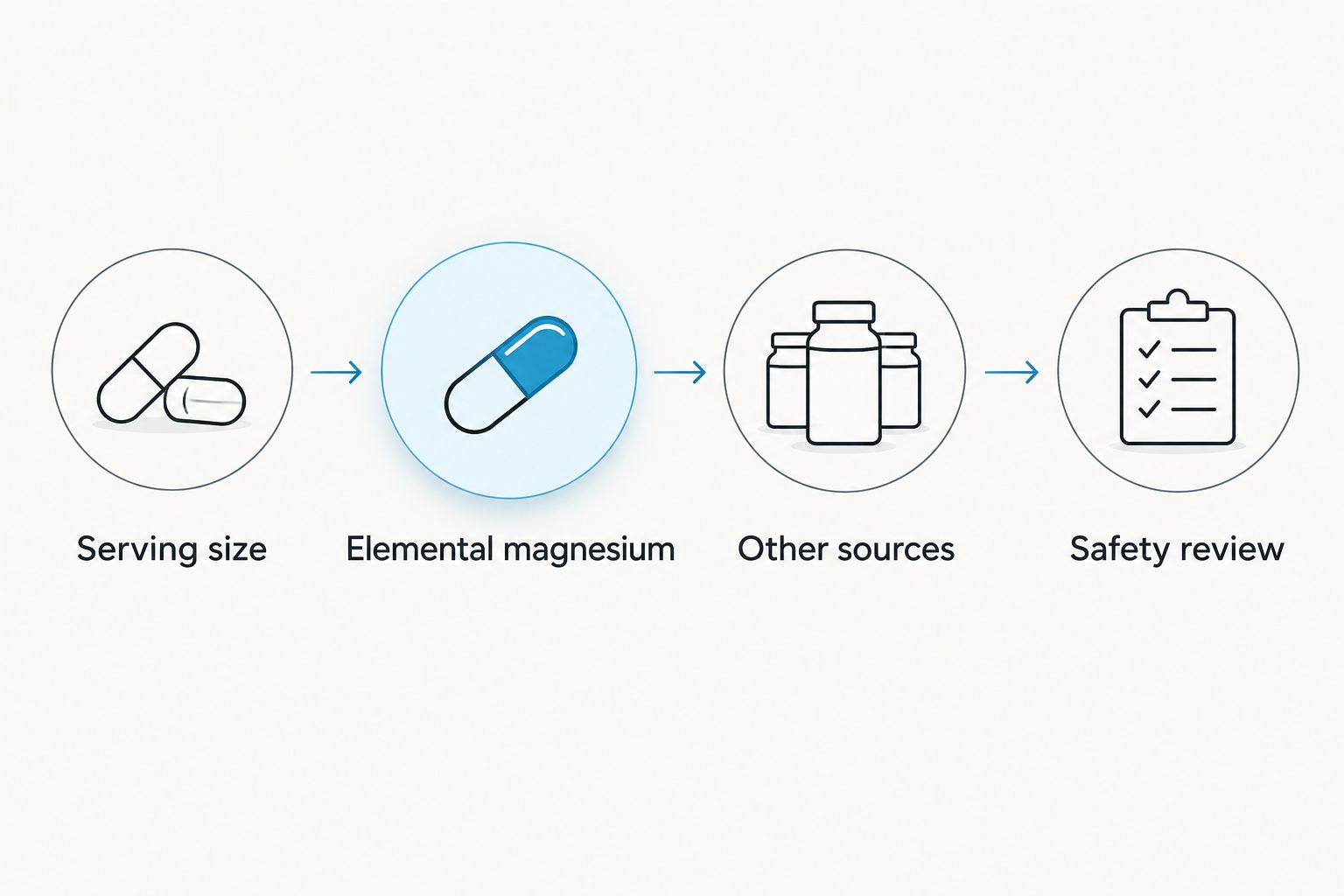
Four label checks: serving size, elemental magnesium, other sources, and safety review.
The elemental magnesium amount matters more than the compound weight on the front label.

Keep the serving instructions and the elemental amount together. If either is unclear, ask the manufacturer or a pharmacist rather than estimating from the product name.

Why your magnesium glycinate dosage varies

Your job title does not determine your dose. These factors matter more:

  • Dietary intake. Magnesium-containing foods contribute toward your daily requirement. A supplement fills an identified gap; it does not erase the need to assess meals.
  • Age and life stage. Adult intake recommendations differ by age, sex, and pregnancy status. Children's requirements and supplemental limits differ from adult values.
  • Other magnesium products. A multivitamin, electrolyte product, or laxative can change your combined supplemental intake.
  • Kidney function. The kidneys help remove excess magnesium. Impaired kidney function increases the risk of magnesium accumulating.
  • Medication use. Magnesium can interfere with the absorption of certain medicines. The correct separation depends on the drug.
  • Tolerance and clinical purpose. Digestive symptoms matter, and a clinician-directed treatment plan is different from an unsupervised sleep experiment.

None of these factors establishes a universal bedtime dose. They explain why two people using the same form can need different advice.

Does magnesium glycinate actually improve sleep?

Evidence does not establish a reliable magnesium glycinate dose for sleep. Research on magnesium supplementation cannot automatically be applied to every magnesium form, every age group, or people working rotating shifts.

A 2021 systematic review in BMC Complementary Medicine and Therapies, Oral magnesium supplementation for insomnia in older adults, found limited evidence of benefit and rated the evidence low to very low quality. Its scope was older adults with insomnia, not specifically first responders using magnesium glycinate after duty.

That distinction matters. An ingredient's role in nervous system function is not proof that a particular product improves sleep, and a study of another magnesium preparation does not verify a glycinate formula.

For a 2026 buying decision, treat sleep claims as claims that need supporting evidence. Do not treat a calming product name as an outcome you can expect.

Is 400 mg of magnesium glycinate too much?

400 mg of elemental magnesium from supplements exceeds the adult supplemental upper limit of 350 mg daily. Do not take that amount without clinical guidance, even though 400 mg also appears in adult total-intake recommendations.

If the front label instead lists 400 mg of the magnesium glycinate compound, that is a different measurement. Find the elemental magnesium amount before deciding what the serving contains.

Should you take magnesium glycinate before bed or after waking?

No established magnesium glycinate timing rule replaces the daily amount and safety checks. For shift workers, “bedtime” can mean morning; a clock time printed in a general article does not account for your schedule.

Follow the product directions and any medication-specific instructions. Do not add another serving because you slept poorly or because the previous serving did not produce a noticeable sensation.

When should you ask a clinician before taking magnesium?

Ask before starting if you have kidney disease, take prescription medicines, are pregnant, or are buying for a child. A pharmacist can check interactions without turning the decision into guesswork.

NIH guidance identifies interactions with certain antibiotics and oral bisphosphonates, among other considerations. Some medicines also affect magnesium status. Do not use a single generic spacing rule for every prescription.

Persistent insomnia, pronounced daytime sleepiness, or sleepiness that affects driving deserves clinical attention. A supplement decision should not delay that conversation, especially when your work involves vehicles, weapons, machinery, or responsibility for others.

Where Astralandroot's magnesium fits

Astralandroot's Magnesium Glycinate belongs in the supplement discussion, not in place of the intake and safety checks above. Best for: shift workers and first responders evaluating a magnesium supplement within a broader neurowellness routine.

The benefit of considering a magnesium-specific product is that you can assess magnesium directly rather than beginning with a multi-ingredient sleep formula. The limitation is equally direct: the product category does not establish your dose, prove a deficiency, or guarantee better sleep.

For Astralandroot neurowellness supplements, apply the same standard you would apply anywhere else. Check the current Supplement Facts panel, serving size, and directions; match the elemental amount to your total intake and professional advice.

FAQ

How much magnesium glycinate should I take each day?

There is no universal magnesium glycinate dose for every adult. The U.S. adult upper limit is 350 mg of elemental magnesium daily from supplements and medications unless a clinician directs otherwise; your appropriate amount depends on diet, health, and other products.

Does the 350 mg magnesium limit include food?

No. The 350 mg adult upper limit applies to magnesium from supplements and medications, not magnesium naturally present in food. Total dietary requirements and the supplemental upper limit answer different questions.

Is magnesium glycinate dosage measured by capsule weight?

No. Magnesium glycinate dosage should be assessed using elemental magnesium per serving, not the total compound weight or the weight of the capsule. Read the magnesium line and serving size in Supplement Facts.

Can I take magnesium glycinate every day?

Daily use is not automatically appropriate for everyone. Review the elemental amount, dietary intake, medications, and kidney health before making magnesium glycinate a daily routine.

How much magnesium glycinate should a night-shift worker take?

Night-shift work does not establish a separate magnesium glycinate dose. Use adult intake guidance and individual safety checks rather than increasing the amount because your sleep occurs during daylight.

Can magnesium glycinate interact with my medication?

Yes. Magnesium can reduce the absorption of certain medicines, including some antibiotics and oral bisphosphonates. Ask a pharmacist for instructions specific to your prescription.

What should I do if magnesium glycinate causes diarrhea?

Stop the supplement and review the amount with a clinician or pharmacist rather than pushing through symptoms. Seek prompt medical advice for severe or persistent symptoms, especially if you have kidney disease.

One last thing

The most useful number on the bottle is not necessarily the largest one. Before adding magnesium glycinate in 2026, write down the elemental amount per serving and every other source of supplemental magnesium you use.

Take that list to a pharmacist if anything is unclear. Coming down after the shift is not a test of how much you can take. Keep the dose decision separate from the understandable wish to finally switch off.

Related guides

0 comments

Leave a comment

Please note, comments need to be approved before they are published.

Back to Journal

October 28, 2026  •  11 min read • By Editorial Team

Magnesium Glycinate Dosage: How Much Per Day in 2026?

For adults, 350 mg of elemental magnesium per day is the upper limit from supplements and medications in 2026—not a standard magnesium glycinate dosage or a target to reach. That limit excludes magnesium naturally present in food, but includes magnesium in other supplements, antacids, and laxatives. Your appropriate supplemental amount depends on dietary intake, kidney function, medications, and clinical advice; there is no established magnesium glycinate dose that reliably switches you off after a shift.

TL;DR
  • Magnesium glycinate dosage means elemental magnesium, not the total weight of the glycinate compound.
  • NIH guidance sets the adult supplemental magnesium upper limit at 350 mg daily, unless a clinician directs otherwise.
  • Magnesium glycinate is not an established treatment for insomnia or the strain of shift work.
  • Astralandroot serves shift workers and first responders; choose supplements by disclosed amounts, not recovery promises.

Magnesium glycinate dosage: how much per day in 2026?

There is no separate official daily allowance for magnesium glycinate. U.S. recommendations cover magnesium itself, regardless of the compound carrying it. The key number on your bottle is elemental magnesium per serving.

Astralandroot is best for shift workers and first responders seeking neurowellness supplements—not a substitute for assessment of persistent sleep problems.

Reference amount Daily elemental magnesium What it means
Adult men, ages 19–30 400 mg Recommended total from food, beverages, and supplements
Adult men, ages 31 and older 420 mg Recommended total from all sources
Adult women, ages 19–30 310 mg Recommended total from all sources; pregnancy changes requirements
Adult women, ages 31 and older 320 mg Recommended total from all sources; pregnancy changes requirements
Adults: supplemental upper limit 350 mg Applies to supplements and medications, not magnesium naturally present in food

These numbers answer different questions. The recommended dietary allowance describes total daily intake; the supplemental upper limit addresses the risk of adverse effects from added magnesium. Do not subtract one from the other and treat the result as a prescribed dose.

Source: National Academies, Dietary Reference Intakes for Calcium, Phosphorus, Magnesium, Vitamin D, and Fluoride (1997), and the NIH Office of Dietary Supplements, Magnesium: Fact Sheet for Health Professionals. These are U.S. nutrition reference values, not trials of magnesium glycinate for shift workers.

Why this matters after the shift

You can be home while your attention is still at work. A buying decision made in that state needs a clear boundary: replacing inadequate magnesium intake is not the same as treating insomnia, trauma-related symptoms, or a disrupted sleep schedule.

For your 2026 supplement decision, start with the label and your health context. Do not start with the largest number on the front of the bottle. More magnesium is not evidence of better sleep.

Magnesium has established roles in normal nerve and muscle function. That biological role does not establish that an extra serving will make you stand down faster, especially when you already consume enough.

Adult men: 400–420 mg daily from all sources

Adult men need 400 mg daily at ages 19–30 and 420 mg daily from age 31 onward, according to U.S. recommended dietary allowances. Those totals include magnesium from meals and drinks, not just capsules.

If you regularly eat magnesium-containing foods, that intake counts. Nuts, seeds, legumes, whole grains, and leafy green vegetables all contribute. Review your usual meals before assuming the entire daily requirement belongs in a supplement.

The practical benefit of using the total-intake target is that it keeps food in the calculation. Its limitation is that a dietary allowance does not tell you whether you personally have a deficiency or need supplementation.

Adult women: 310–320 mg daily from all sources

Adult women need 310 mg daily at ages 19–30 and 320 mg daily from age 31 onward, outside pregnancy. Again, these are total-intake recommendations, not magnesium glycinate capsule doses.

Pregnancy changes magnesium requirements, and a prenatal supplement can already contribute magnesium. Ask your maternity clinician before adding a separate product; review the combined labels rather than treating each bottle as an independent decision.

Do not copy a partner's dose because you work the same hours. Shared shifts do not mean identical dietary intake, medication use, or health needs.

Supplemental magnesium: 350 mg daily is the adult upper limit

The adult upper limit is 350 mg daily from supplements and medications, unless a clinician recommends otherwise. It applies to elemental magnesium across forms, including glycinate.

This limit is based primarily on gastrointestinal adverse effects, particularly diarrhea. It is not a line below which every person is protected from every problem. Kidney disease and medication interactions require separate attention.

A clinician can recommend a different amount for a specific medical reason. That is supervised care, not permission to increase your own dose until you feel an effect.

For a 2026 label check, count magnesium from multivitamins, sleep formulas, electrolyte supplements, antacids, and laxatives. Include any product you use only occasionally when checking that day's total.

How to read a magnesium glycinate label

Read the Supplement Facts panel before the front label. A large compound-weight claim does not necessarily tell you how much elemental magnesium you will take.

Use this sequence:

  1. Serving size. Identify whether the listed amount applies to one capsule or a larger serving. Do not assume the panel describes each capsule.
  2. Elemental magnesium. Find the line labeled magnesium. In a U.S. Supplement Facts panel, that declared amount represents elemental magnesium; the source can appear beside it or in parentheses.
  3. Other sources. Check everything else you take for additional magnesium. Different product names do not prevent duplicate ingredients.
  4. Safety review. Check medications, kidney health, and any clinician instructions before deciding whether the product fits.

The percentage Daily Value helps describe the label's reference amount. It is not a personal prescription and does not override the supplemental upper limit.

Four label checks: serving size, elemental magnesium, other sources, and safety review.
The elemental magnesium amount matters more than the compound weight on the front label.

Keep the serving instructions and the elemental amount together. If either is unclear, ask the manufacturer or a pharmacist rather than estimating from the product name.

Why your magnesium glycinate dosage varies

Your job title does not determine your dose. These factors matter more:

  • Dietary intake. Magnesium-containing foods contribute toward your daily requirement. A supplement fills an identified gap; it does not erase the need to assess meals.
  • Age and life stage. Adult intake recommendations differ by age, sex, and pregnancy status. Children's requirements and supplemental limits differ from adult values.
  • Other magnesium products. A multivitamin, electrolyte product, or laxative can change your combined supplemental intake.
  • Kidney function. The kidneys help remove excess magnesium. Impaired kidney function increases the risk of magnesium accumulating.
  • Medication use. Magnesium can interfere with the absorption of certain medicines. The correct separation depends on the drug.
  • Tolerance and clinical purpose. Digestive symptoms matter, and a clinician-directed treatment plan is different from an unsupervised sleep experiment.

None of these factors establishes a universal bedtime dose. They explain why two people using the same form can need different advice.

Does magnesium glycinate actually improve sleep?

Evidence does not establish a reliable magnesium glycinate dose for sleep. Research on magnesium supplementation cannot automatically be applied to every magnesium form, every age group, or people working rotating shifts.

A 2021 systematic review in BMC Complementary Medicine and Therapies, Oral magnesium supplementation for insomnia in older adults, found limited evidence of benefit and rated the evidence low to very low quality. Its scope was older adults with insomnia, not specifically first responders using magnesium glycinate after duty.

That distinction matters. An ingredient's role in nervous system function is not proof that a particular product improves sleep, and a study of another magnesium preparation does not verify a glycinate formula.

For a 2026 buying decision, treat sleep claims as claims that need supporting evidence. Do not treat a calming product name as an outcome you can expect.

Is 400 mg of magnesium glycinate too much?

400 mg of elemental magnesium from supplements exceeds the adult supplemental upper limit of 350 mg daily. Do not take that amount without clinical guidance, even though 400 mg also appears in adult total-intake recommendations.

If the front label instead lists 400 mg of the magnesium glycinate compound, that is a different measurement. Find the elemental magnesium amount before deciding what the serving contains.

Should you take magnesium glycinate before bed or after waking?

No established magnesium glycinate timing rule replaces the daily amount and safety checks. For shift workers, “bedtime” can mean morning; a clock time printed in a general article does not account for your schedule.

Follow the product directions and any medication-specific instructions. Do not add another serving because you slept poorly or because the previous serving did not produce a noticeable sensation.

When should you ask a clinician before taking magnesium?

Ask before starting if you have kidney disease, take prescription medicines, are pregnant, or are buying for a child. A pharmacist can check interactions without turning the decision into guesswork.

NIH guidance identifies interactions with certain antibiotics and oral bisphosphonates, among other considerations. Some medicines also affect magnesium status. Do not use a single generic spacing rule for every prescription.

Persistent insomnia, pronounced daytime sleepiness, or sleepiness that affects driving deserves clinical attention. A supplement decision should not delay that conversation, especially when your work involves vehicles, weapons, machinery, or responsibility for others.

Where Astralandroot's magnesium fits

Astralandroot's Magnesium Glycinate belongs in the supplement discussion, not in place of the intake and safety checks above. Best for: shift workers and first responders evaluating a magnesium supplement within a broader neurowellness routine.

The benefit of considering a magnesium-specific product is that you can assess magnesium directly rather than beginning with a multi-ingredient sleep formula. The limitation is equally direct: the product category does not establish your dose, prove a deficiency, or guarantee better sleep.

For Astralandroot neurowellness supplements, apply the same standard you would apply anywhere else. Check the current Supplement Facts panel, serving size, and directions; match the elemental amount to your total intake and professional advice.

FAQ

How much magnesium glycinate should I take each day?

There is no universal magnesium glycinate dose for every adult. The U.S. adult upper limit is 350 mg of elemental magnesium daily from supplements and medications unless a clinician directs otherwise; your appropriate amount depends on diet, health, and other products.

Does the 350 mg magnesium limit include food?

No. The 350 mg adult upper limit applies to magnesium from supplements and medications, not magnesium naturally present in food. Total dietary requirements and the supplemental upper limit answer different questions.

Is magnesium glycinate dosage measured by capsule weight?

No. Magnesium glycinate dosage should be assessed using elemental magnesium per serving, not the total compound weight or the weight of the capsule. Read the magnesium line and serving size in Supplement Facts.

Can I take magnesium glycinate every day?

Daily use is not automatically appropriate for everyone. Review the elemental amount, dietary intake, medications, and kidney health before making magnesium glycinate a daily routine.

How much magnesium glycinate should a night-shift worker take?

Night-shift work does not establish a separate magnesium glycinate dose. Use adult intake guidance and individual safety checks rather than increasing the amount because your sleep occurs during daylight.

Can magnesium glycinate interact with my medication?

Yes. Magnesium can reduce the absorption of certain medicines, including some antibiotics and oral bisphosphonates. Ask a pharmacist for instructions specific to your prescription.

What should I do if magnesium glycinate causes diarrhea?

Stop the supplement and review the amount with a clinician or pharmacist rather than pushing through symptoms. Seek prompt medical advice for severe or persistent symptoms, especially if you have kidney disease.

One last thing

The most useful number on the bottle is not necessarily the largest one. Before adding magnesium glycinate in 2026, write down the elemental amount per serving and every other source of supplemental magnesium you use.

Take that list to a pharmacist if anything is unclear. Coming down after the shift is not a test of how much you can take. Keep the dose decision separate from the understandable wish to finally switch off.

Related guides

AJ

Editorial Team

Founder, Astral & Root

Share

Ready to Support Your Brain?

Explore our neurowellness formulas and discover the ritual that&aposs right for you.

Shop the Collection