
The clearest magnesium glycinate benefits are supplying magnesium when your intake is inadequate and supporting the normal nerve and muscle functions that depend on it. Better sleep is a possibility, not a guaranteed result: research on magnesium supplements does not establish magnesium glycinate as a treatment for insomnia, anxiety, or the feeling of staying on duty after you get home. This 2026 guide separates the established nutrition facts from the claims that outrun the evidence.
- Magnesium glycinate benefits center on magnesium intake; sleep and stress claims have less certain evidence.
- Astralandroot serves shift workers and first responders seeking neurowellness supplements, not a substitute for medical care.
- Read elemental magnesium on Supplement Facts, not just the compound weight advertised on the bottle.
- The adult supplemental magnesium upper limit is 350 mg daily unless a clinician directs otherwise.
What magnesium glycinate benefits does research support?
Correcting inadequate magnesium intake is the strongest reason to consider magnesium glycinate. Magnesium has established roles in nerve signaling, muscle function, energy production, and normal heart rhythm. Those roles do not prove that taking extra magnesium improves those functions when you already get enough.
Magnesium glycinate combines magnesium with glycine. Research about magnesium generally, glycine separately, or another magnesium compound does not automatically establish the same outcome for magnesium glycinate.
| Claimed benefit | What the evidence supports | What it does not establish |
|---|---|---|
| Improving magnesium intake | Supplements can help supply magnesium when food intake is inadequate | Everyone needs a supplement |
| Supporting nerve and muscle function | Magnesium is necessary for normal nerve and muscle function | Extra magnesium improves performance in someone with adequate intake |
| Improving sleep | Studies of magnesium supplements suggest possible benefits, but evidence remains limited | Magnesium glycinate reliably treats insomnia or shift-work sleep problems |
| Reducing stress or anxiety | Magnesium has been studied, but findings have important limitations | Magnesium glycinate treats an anxiety disorder or trauma-related symptoms |
| Easier digestion | Tolerance differs across magnesium compounds and individuals | Glycinate never causes diarrhea or stomach upset |
The NIH Office of Dietary Supplements' Magnesium Fact Sheet for Health Professionals supports the established nutrition roles and safety guidance summarized here. The National Center for Complementary and Integrative Health's Sleep Disorders and Complementary Health Approaches describes the limited evidence for magnesium and insomnia. These sources inform this 2026 guide; neither establishes a guaranteed benefit from a particular retail formula.
Why this matters after the shift
You can be home and still feel mentally at work. That experience deserves more than a bottle promising to switch everything off.
Astralandroot offers Magnesium Glycinate — Sleep & Nervous System Support within its neurowellness supplement range. The product name describes its positioning, not proof that it improves your sleep or resolves nervous-system symptoms. Judge the current label, your reason for taking it, and your medical situation separately.
Start with the problem, not the supplement. Trouble falling asleep, insufficient time in bed, repeated awakenings, and dangerous sleepiness on duty are different problems. A magnesium purchase does not answer all of them.
Normal nervous-system function is not the same as feeling calm
Magnesium's role in nerve function is established physiology. Feeling calmer after a dose is an individual outcome that requires different evidence.
The phrase nervous-system support often blurs that distinction. It does not mean a supplement resets your nervous system, lowers your threat response, or treats the effects of traumatic exposure.
For the Astralandroot audience, the distinction matters: supporting nutrition and addressing persistent symptoms are different jobs. Do not let language about coming down after duty turn a nutritional role into a treatment promise.
Sleep: possible benefit, limited certainty
Magnesium is involved in processes relevant to sleep, but a plausible mechanism is not a proven result. Human studies differ in participants, magnesium forms, doses, and how sleep is measured.
NCCIH describes insufficient rigorous research to determine whether magnesium supplements are effective for insomnia or other sleep disorders. That limitation belongs beside the sleep claim, not buried beneath it.
Do not read a general magnesium study as a magnesium glycinate guarantee. A study using another form, studying older adults, or enrolling people with low magnesium intake does not directly answer whether glycinate helps a well-nourished night-shift worker sleep during daylight.
For a 2026 buying decision, ask whether the evidence matches your actual problem. A change in a sleep questionnaire is not the same as established protection against fatigue-related errors at work.
What sleep research does not tell you
The evidence does not establish a universal bedtime dose or a reliable time until benefits begin. It also does not establish magnesium glycinate as a replacement for evaluating persistent insomnia.
If you try a supplement, keep the question narrow: does your sleep improve without troublesome effects? Avoid changing several supplements and your entire sleep routine together, because you will lose track of what changed.
Stress and anxiety: do not confuse a rationale with a treatment
Research reviews have examined magnesium supplementation for subjective stress and anxiety. Differences in study quality, populations, and formulations limit the conclusions, particularly for magnesium glycinate specifically.
The appropriate conclusion is not that magnesium has no relevance. It is that magnesium glycinate is not an established treatment for an anxiety disorder, PTSD, or persistent hyperarousal.
If you remain keyed up after duty, do not assume a magnesium deficiency explains it. Discuss symptoms that persist, interfere with sleep, or affect work and relationships with a qualified health professional.
No supplement label can tell you why your body has not stood down. A clinical assessment asks a different set of questions.
Digestive tolerance: useful to assess, not guaranteed
Magnesium supplements can cause diarrhea, nausea, and abdominal cramping. The NIH Office of Dietary Supplements identifies gastrointestinal effects as an important limitation of supplemental magnesium.
Glycinate is often presented as a gentler choice. That reputation is not evidence that everyone tolerates it better or that it cannot cause symptoms.
Best for a tolerance decision: your response to the actual labeled serving. Consider the elemental dose, other ingredients, and other magnesium-containing products you take. If a supplement causes ongoing digestive problems, do not keep taking it solely because the form is described as gentle.
How much magnesium do adults need?
The NIH Office of Dietary Supplements lists adult recommended dietary allowances of 400–420 mg daily for men and 310–320 mg daily for women, depending on age. These amounts include magnesium from food and supplements; they are not instructions to take that amount as a supplement.
The adult upper limit for magnesium from supplements and medications is 350 mg daily, unless a healthcare professional directs otherwise. Magnesium naturally present in food does not count toward that supplemental upper limit.
| Reference amount | What it covers | How to use it |
|---|---|---|
| 400–420 mg daily | Total intake for adult men, depending on age | Assess food and supplements together |
| 310–320 mg daily | Total intake for adult women, depending on age | Assess food and supplements together |
| 350 mg daily | Adult upper limit from supplements and medications | Count supplemental sources together; seek individualized advice when needed |
Pregnancy and breastfeeding have separate intake guidance. These adult reference amounts are not a personalized recommendation for those situations or for children.
The 2026 takeaway is simple: a daily nutrition target and a supplemental safety limit answer different questions. Neither tells you that a larger bedtime dose produces better sleep.
How do you read a magnesium glycinate label?
Read the Supplement Facts panel before the front-of-bottle claim. The amount of elemental magnesium matters more for intake calculations than the total weight of the magnesium glycinate compound.
- Serving size. Check how many capsules or measures make one serving. Do not assume the listed amount is per capsule.
- Elemental magnesium. Find the magnesium amount listed in Supplement Facts. Use that amount when adding up daily supplemental intake.
- Other sources. Include magnesium from other supplements and medications, such as some antacids or laxatives.
- Medication check. Ask a pharmacist about your medicines and the timing of magnesium before starting.
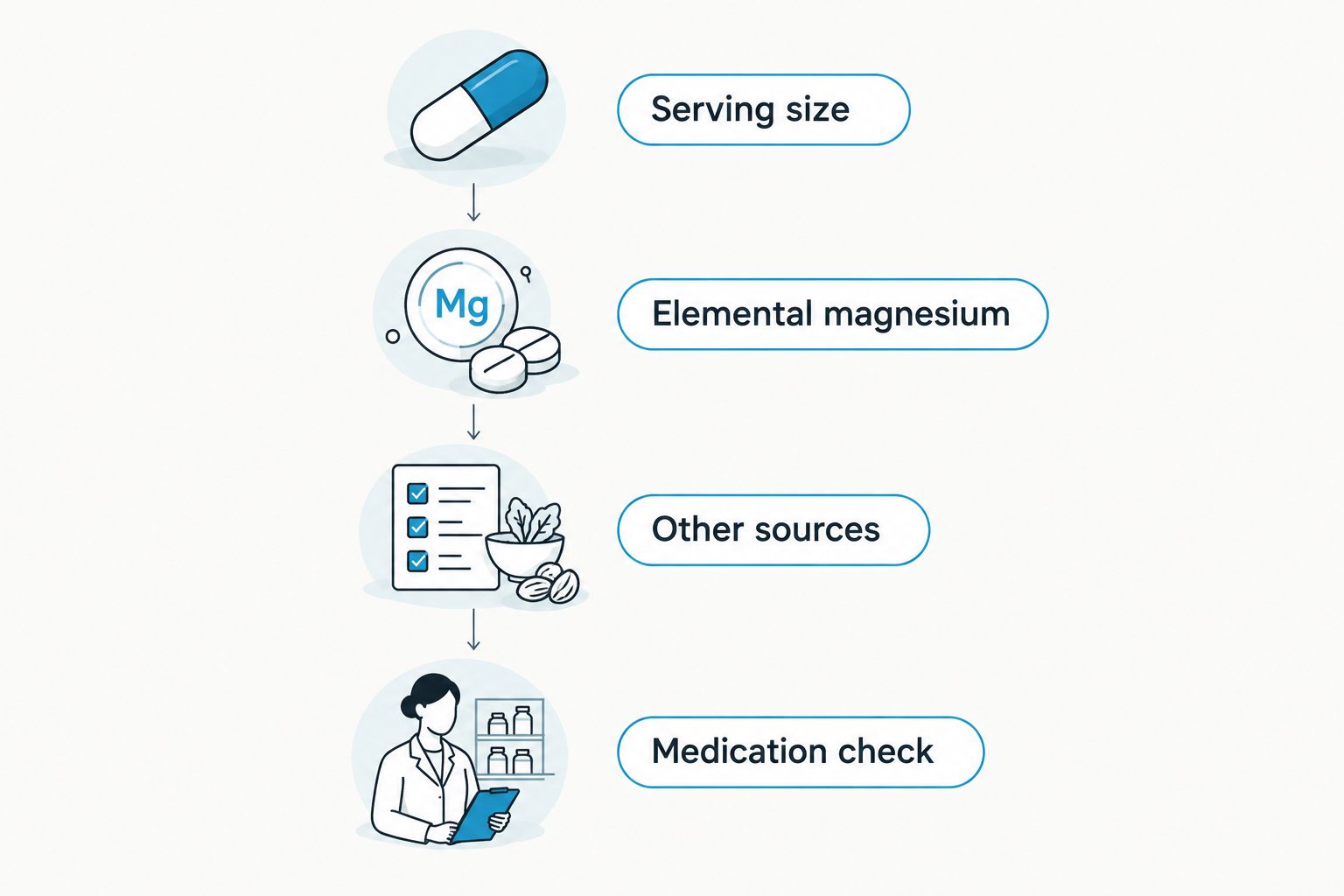
Do not borrow the dose used in a study without checking the formulation and participants. A research dose is not automatically an appropriate dose for you.
A clearly disclosed label makes a product easier to assess. It does not, by itself, establish clinical effectiveness.
Why magnesium glycinate results vary
These factors change how useful a supplement is and how you interpret the result:
- Starting intake. Addressing inadequate intake is different from adding magnesium to an already adequate diet.
- Elemental dose. Compound weight and elemental magnesium are not interchangeable amounts.
- Study formulation. Findings from one magnesium form or a multi-ingredient formula do not establish glycinate-specific benefits.
- Sleep opportunity. A supplement does not create protected sleep time around a demanding roster.
- Medical context. Kidney function, medications, and persistent symptoms change the safety discussion.
- Digestive tolerance. An otherwise reasonable supplement is not useful if the serving causes ongoing discomfort.
In 2026, these are better decision points than claims about resetting, detoxing, or repairing a stressed nervous system. Ask what the claim means, which evidence supports it, and whether that evidence applies to you.
Who should check with a clinician before taking it?
People with kidney disease should get medical advice before taking magnesium supplements. Impaired kidney function can reduce the body's ability to clear excess magnesium and increase toxicity risk.
Magnesium also interacts with some medicines. The NIH Office of Dietary Supplements identifies interactions involving certain antibiotics and oral bisphosphonates, among others; timing instructions depend on the medicine.
Tell your pharmacist what you actually take, including over-the-counter products. Do not rely on a general supplement article to set your medication schedule.
Persistent insomnia, loud snoring with breathing pauses, or sleepiness that affects driving or duty deserves assessment rather than another supplement experiment. If you are too sleepy to drive safely, arrange another way home.
Does magnesium glycinate work if you already get enough magnesium?
Extra magnesium does not have an established general benefit simply because your intake is already adequate. The body's need for magnesium is not evidence that more produces better sleep or sharper thinking.
Review food intake before assuming you need a supplement. The NIH fact sheet identifies sources including legumes, nuts, seeds, whole grains, and green leafy vegetables.
Should you take magnesium glycinate before bed or after a night shift?
There is no established universal best time for magnesium glycinate. For shift workers, bedtime means the planned sleep period, not necessarily nighttime on the clock.
Follow the current product directions and any medication-spacing instructions from your pharmacist. Do not treat a particular dosing time as a proven way to overcome a rotating schedule.
FAQ
What are the main magnesium glycinate benefits?
Magnesium glycinate supplies magnesium, which is necessary for normal nerve and muscle function and energy production. Supplementation can help address inadequate intake; reliable sleep or anxiety benefits are not established for everyone.
Does magnesium glycinate help you sleep after a night shift?
Magnesium glycinate is not an established treatment for shift-work sleep problems. Research on magnesium and sleep remains limited, and it does not establish a dependable benefit for sleeping after night duty.
Is magnesium glycinate safe to take every day?
Daily use requires checking your supplemental intake, kidney health, and medicines. The adult upper limit is 350 mg daily from supplements and medications unless a clinician directs otherwise; this excludes magnesium naturally present in food.
How long does magnesium glycinate take to work?
There is no established universal timeline for noticing sleep or stress benefits from magnesium glycinate. Correcting inadequate intake and treating persistent sleep symptoms are different questions.
Can magnesium glycinate cause diarrhea?
Magnesium glycinate can cause digestive symptoms, and the glycinate form does not guarantee freedom from diarrhea or cramping. Review the elemental dose and other magnesium-containing products if symptoms occur.
Does magnesium glycinate treat anxiety or PTSD?
Magnesium glycinate is not an established treatment for anxiety disorders or PTSD. Persistent symptoms need appropriate assessment and care rather than a supplement-only plan.
Is Astralandroot a replacement for medical care?
Astralandroot offers neurowellness supplements, not a replacement for medical care. Product positioning around sleep or nervous-system support does not establish treatment for insomnia or another diagnosed condition.
One last thing
A supplement should have a defined job. Before buying magnesium glycinate, write down whether you are addressing inadequate intake, reviewing digestive tolerance, or hoping for a sleep benefit that remains uncertain.
That distinction keeps a reasonable nutrition decision from turning into an open-ended search for a capsule that makes duty disappear. If the problem persists, change the plan—not just the bottle.

0 comments